
The market closed around them a few steps past the gate, and the prophet’s voice went under, swallowed by a hundred others.
Lehi had walked these lanes since he was smaller than the boys darting between the stalls. He could have crossed the Maktesh with his eyes shut: down between the walls, past potters and dyed wool hung like banners, to the shaded row where oil and wine changed hands. The smells came in their old order. Clay dust. Dye. Sesame and smoke. Then green, sharp oil and men arguing over it.
He wiped his fingers on his robe. He had given his cloth to Laban, and the oil had not quite come off his hands.
Nephi kept the donkeys clear of a porter bent beneath firewood. He had not spoken since the gate. Lehi’s elder sons filled silence the moment it opened; Nephi let it sit, as though it might hold something worth finding.
“You may as well ask,” Lehi said.
Nephi looked at him over the donkeys’ backs. “Ask what?”
“Whatever you’ve been carrying since the gate.”
Nephi took a few steps before answering. “Why did you tell him to mark it full? The measure was short. I saw it.”
“So did I.”
“Then—”
“It was short because I turned without looking.” Lehi stepped around a basket of onions someone had left in the lane. “Some of that oil is on Laban’s sleeve. That isn’t a loss for the man who brought it down from the hills to carry.”
Nephi seemed to weigh that, the way he weighed most things. “He wouldn’t have known the difference.”
“I would have.”
Hanan ran the oil stall his father had run before him. He was a broad, loud man who claimed he had never been cheated, which Lehi suspected meant he had never noticed. He pulled the stopper from the nearest jar, smelled it, and looked up.
“Yours, or from the hills?”
“From the hills.”
“I thought so.” Hanan pushed the stopper back in. “Yours has more bite.”
Lehi’s own oil went to the great houses of the upper city and to the caravan for Gaza, and when there was extra, Hanan got it. Most of what Lehi sold him came down from the hill villages, from men with a few terraces and a stone press and no standing in the Maktesh.
Hanan slapped one donkey’s flank and named his customary low price, a little lower for the hills.
Lehi answered with his customary high one. They met in the middle by way of Hanan’s cousin’s wedding, a cracked jar from Lehi’s last delivery, and the rising cost of feeding a household since the siege.
“Weigh it,” Lehi told Nephi.
Hanan raised his eyebrows. Nephi untied the bag from his father’s belt and took out the weights: smooth, domed stones cut with their measures. Nephi set the weights in one pan while Hanan counted broken silver and small rings into the other until the beam hung level.
It held for a moment, then dipped a hair toward the silver. Nephi lifted the smallest piece of silver from the pan and handed it back.
Hanan laughed. “You’ve taught him to rob himself.”
“A false balance is an abomination to the Lord,” Lehi said mildly. “But a just weight is his delight.”
“The Lord doesn’t have a household to feed this spring.” Hanan swept the silver into a pouch and handed it over. Then, more quietly: “You were at the gate. Did you hear him?”
“I heard him.”
“My brother-in-law says it’s all nonsense. He says Pharaoh will never let Babylon sit on our necks. Egypt needs us standing between them and the river.” Hanan’s eyes went past Lehi to the end of the row, where two men in the dress of the palace were looking over a stall of dried figs. He lowered his voice still further. “What do you say?”
Lehi had been asked the same question twice today, in the same low voice. “The Egyptians have always needed us to stand between them and Babylon,” he said. “But they’ve never come when we needed them.”
Hanan grunted. It was not quite agreement. A boy leaned over one of his jars, and Hanan turned to shout at him. The conversation was over.
They had nearly finished unloading when a voice called Lehi’s name from across the lane. It was Pentu, a trader from the delta who came up every spring with linen and papyrus and went home with oil and wine, and who had been calling Lehi his friend for fifteen years without either of them being quite sure how it had started. He greeted Lehi in Egyptian, loudly, with a hand on his shoulder, and asked after his wife, his vineyards and his health, in that order.
Lehi answered in kind. Then he nodded at Nephi.
Nephi hesitated, then said in careful Egyptian that his father was well and his mother was well and the vineyards were well, and that he hoped the river had been generous to Pentu’s fields.
Pentu stared at him, then laughed and clapped him on the arm. “He talks like a scribe,” he told Lehi. “Like an old scribe. Where did he learn to talk like that?”
“From me,” Lehi said.
“That explains it.”
Nephi flushed but did not look away. Lehi was surprised by how proud he felt.
Pentu’s face changed when Lehi asked about the road. “Quiet as far as Gaza,” he said. “After that, everyone has a different story. Babylon is coming. Babylon is not coming. Pharaoh will march in the summer. Pharaoh will not march at all.” He shrugged. “In my country, when the merchants all start telling different stories, the wise ones go home early.”
“Are you going home early?”
Pentu smiled, but not with his eyes. “I am thinking about it.”
Pentu would not let them leave before eating. They sat out the heat behind his stall while he told stories, haggled with buyers, and made Nephi recite the Egyptian months. By the time they stepped back into the lane, the shadows had begun to lean the other way.
They turned the donkeys toward home. Before they had gone far, Lehi saw the woman in the dark shawl.
She stood apart from the press, a small jar in one hand and scraps of silver in the other. The seller was explaining that it was not enough.
Lehi remembered the prophet’s answer: Not as soon as you have been told.
She did not argue. She nodded as people do when they have stopped expecting things and turned to go.
Lehi went back to Hanan’s stall. “The woman in the dark shawl,” he said. “Fill her jar. Put it on my account.”
Hanan sighed but sent his boy across with a ladle and a full measure. Lehi watched him fill the woman’s jar. She searched the crowd for whoever had done it.
He turned away before she could find him. He told himself he was sparing her the need to thank him. But while her eyes were searching the crowd, part of him had wanted to be found. He knew it, and he did not like knowing it.
When he turned back, Nephi was watching him.
“Her son is in Babylon,” Lehi said quietly.
“I know. I heard her at the gate.”
They led the donkeys out of the Maktesh without talking. The animals walked easier without their loads. With the oil sold and the woman’s jar full, Lehi felt he ought to be lighter too. He was not.
They went home the long way, past the temple approaches. Lehi could not have said why; it was where his feet took him. Twice they stood aside while carts groaned past.
Six guards stood along the foot of the temple steps, staffs grounded, doing nothing but being seen. Lehi had never seen them posted there. One had stood near Laban that morning. Below them, perhaps twenty people had gathered around the same thin, dust-covered prophet.
At the gate his voice had been for a hundred people. Now it was for twenty, and Lehi stopped to hear it.
“The Lord has not forgotten you,” the prophet was saying. “Do you hear me? He has sent to you, rising early and sending, and you have not listened. But he has not stopped sending.” He looked down at the people nearest him, a potter with clay still on his arms, two women with water jars, an old man leaning on a stick. “Come now, and let us reason together, says the Lord. Though your sins be as scarlet, they shall be as white as snow. Though they be red like crimson, they shall be as wool.”
Everyone knew the words. Isaiah had spoken them in this city when Lehi’s great-grandfather was a boy, and they had been read, sung, and argued over ever since.
He had never heard them like this, in the street, from a man who seemed to think they were true right now.
“If you are willing and obedient,” the prophet said, “you shall eat the good of the land. But if you refuse and rebel—”
“We’ll be eaten by the sword,” a man called from the back. “We know. You said.” A few people laughed. Someone near the front told the man to be quiet. Another voice answered from the back, and for a moment the smaller crowd sounded like the one at the gate.
Lehi did not move. Beside him, Nephi stood with the lead rope slack in his hand.
At the foot of the steps, the guard from the gate turned his head and looked at them. He looked a moment longer than a man looks at a stranger: at Lehi, at the loaded donkeys, at Nephi. Then he looked away.
Laban’s warning came back to him: Men are taking note of who listens.
Lehi stayed where he was until the prophet had finished. By then the sun was low over the western hills, and the light on the temple steps had turned to gold.
Afterward, as they climbed the street toward the upper city, Nephi spoke without being asked.
“Do you believe him now?”
Lehi drew breath. “I—” He closed his mouth. “I don’t know.”
Nephi did not press him. He only matched his father’s pace.
For a while there was only the sound of hooves on the stones. Then Lehi tried again.
“I believe the Lord has warned this city before,” he said. “I believe he has been patient with it for a long time. And I believe that man is not lying. Whether he is right—” He shook his head. “I am afraid of finding out that he is, and that I stood in the street and listened and did nothing.”
“What would you have done?”
Lehi did not answer. After a while Nephi stopped waiting for him to.
The house had stood for three generations on an upper-city street where the markets were only a murmur. Lehi had been born there and never imagined dying anywhere else.
Sariah sat beneath the courtyard fig tree with the household accounts across her knees. Beside her, Milcah read tallies from a potsherd and frowned at one as though it had offended her personally.
Noa reached them first, racing down the roof stairs, ducking under a donkey’s neck, and fastening herself to Nephi’s arm.
“Was the Egyptian there? Milcah said he would be there. Did he bring—”
“He brought it,” Nephi said, and from somewhere in his robe he produced a small blue bead on a thread, the glazed kind the delta traders sold for luck. Noa held it up to the light as though it were a jewel from Pharaoh’s own neck.
Lehi had not seen him buy it. He had been at Nephi’s side the whole day, and he had not seen.
Sariah had looked up when the gate opened. She looked at the donkeys and their empty packs, then at Lehi’s face, and set the board aside.
“You sold it all,” she said.
“To Hanan.”
“Mm. For less than it was worth.” She was smirking before he answered.
“For about what it was worth.”
“A sixth less,” Milcah said, without looking up from her sherd. “Mother said he’d try for a sixth.”
“Your mother,” Lehi said, “should sell the oil herself.”
“Your mother,” said Sariah, “has been telling your father so for twenty-six years.” She rose and took his hands, and the smile went out of her face as she frowned at the oil on them. “Something happened at the gate.”
He might have told her then. But the gate opened again behind him and Laman came in, dusty from the road, with Lemuel at his heels.
They had spent the day at the family land outside the city, where the olives were flowering and old Gaddi had lost two lambs. A dark-crusted scratch ran down Laman’s forearm beneath his torn sleeve.
“It was a jackal,” Lemuel announced, before anyone had asked. “Two of them, maybe. They went down into the wadi, and Laman went in after them. Into the thorns. Gaddi told him not to. I told him not to.”
“You came in after me,” Laman said.
“Because you went in.”
“Did you catch them?” Noa asked, letting go of Nephi to stare at the arm.
“No.” Laman sat on the trough. Sam came from the house with a bowl of water and poured it over the scratch. Laman winced without complaint. “But I found where they’re getting through. The wall’s down on the far side of the lower terrace. I’ll mend it next week, and I’ll sit up in the fold until it’s mended.”
“Gaddi can sit up in the fold,” Lehi said. “It’s what we pay him for.”
“Gaddi’s eyes aren’t what they were. It wasn’t his fault, Father. He’s ashamed enough already. I told him it was the wall.” Laman looked up with the same wish Lehi had seen since he was a boy carrying water for the vines: to be found sufficient. “It’s our land. Someone has to.”
“He’s been planning the wall the whole way home,” Lemuel said. “Every stone. I know more about that wall than I know about my own feet.” Then, grinning: “Nephi gets the market and the Egyptian, and we get Gaddi and a jackal. I want it known that I think this is unjust.”
Laman laughed, then Sam and Lehi. Over Laman’s bent head, Sariah gave Lehi a look he did not understand. A servant came for the donkeys, and the moment passed.
Ishmael arrived as the lamps were being lit, which was how he arrived everywhere.
He had never waited to be asked to supper. He came through the gate with wine under one arm and his voice ahead of him, a white-bearded man gone soft with age whose laugh began near his belt. His wife sent greetings and cheese. She was home with a coughing grandson and had sent Ishmael away so he would stop insisting it was nothing.
He kissed Sariah on both cheeks and told her she grew younger every year, which he had been telling her since before she was married. He told Laman he looked like a man who had wrestled a thornbush and lost. Then he pinched Noa’s chin and asked whether she was betrothed yet.
“I’m ten.”
“That is no excuse.”
Noa laughed, then glanced at Milcah, as if seventeen might have an answer ten did not. Milcah reached for the bread without looking up.
With the shutters open, they gathered in the upper room around lentils, bread, Ishmael’s cheese, spring onions, and wine. Ishmael made sure everyone knew his was better than Lehi’s. Lehi gave thanks, and the room filled with the noise of family at day’s end.
Ishmael was a man of Ephraim, more than ten years older than Lehi. His vineyards lay north of the city, and his overfull house stood two streets away, home to a wife, two married sons and their families, and five daughters he constantly complained about but would have died for without hesitation.
“Five,” he said, pointing a piece of bread at Lehi. “I have five daughters. You have two, and you look tired. Do you know what it costs to keep five girls in sandals?”
“I know what one of mine costs in papyrus,” Lehi said. Milcah, who had been caught twice that winter practicing her letters on the backs of old accounts, went pink and said nothing.
Ishmael pointed his bread at Milcah. “What did you expect? You named her for one of the daughters of Zelophehad.” He looked at both girls. “You know the story.” They did. Everyone did. Ishmael told it anyway. “Milcah and Noa were daughters of Zelophehad, of Manasseh, like your father. When he died without sons, they stood before Moses and all Israel and asked for his land. Asked Moses. And the Lord said they were right.” He shook his head at Lehi. “You named your daughters for women who stood before Moses and spoke for themselves. What did you think Milcah would do when she found a reed pen?”
Milcah looked down. “I only used the backs.”
The table laughed, and after a moment Milcah did too. Lehi saw Sariah hide her smile behind her cup.
It was Ishmael, of course, who brought up the gate. He did it the way he did everything, without lowering his voice.
“They tell me you were down there this morning,” he said, “standing in the crowd with the rest of the idlers, listening to the madman.”
“I was there.”
“Well.” Ishmael tore his bread. “I’ve seen five kings on that throne, my friend, and I don’t know how many madmen at that gate. Josiah’s prophets. Jehoiakim’s prophets. They all say the same thing, and here we all are.”
Noa had gone quiet. Lehi did not notice until she spoke, and then he realized she had been quiet for some time.
“Father. Is Babylon going to come back?”
The room did not go silent, but Lemuel stopped with his cup halfway to his mouth.
“The girls at the well were saying it,” Noa said. “They said the prophet said they would take everyone this time. Not just the king.” She looked at Nephi, and then at the bead on its thread around her wrist, and then at her father. “Would they take Nephi?”
Nephi’s eyes dropped to the bead around her wrist.
No one answered fast enough, and the rest came in a rush.
“Would they take Sam? And Laman and Lemuel? And Milcah, and Mother, and you?” Her eyes went around the table, and they landed on Ishmael. “And your girls? And the babies?”
Ishmael opened his mouth, but Laman answered first. He leaned across the table toward Noa and spoke gently, the way he spoke to the lambs.
“Noa, listen to me.” He touched the bead at her wrist. “When Hezekiah was king, the Assyrians surrounded Jerusalem, and the Lord sent them away. This is his city. He’ll defend it again.” He smiled at her. “They won’t take any of us. They’d have to get past me first.”
Noa looked at him, and some of the fear went out of her shoulders.
Laman looked across the table at his father. He said nothing, but Lehi knew the look from every year of his son’s life. Tell her I’m right.
Lehi had taught him that story, sitting on this same floor when Laman was smaller than Noa. He had always ended it where Laman ended it: the Assyrians gone, Jerusalem safe.
“Hezekiah,” Lehi heard himself say, “tore his clothes, and covered himself with sackcloth, and went into the house of the Lord, and wept. That came before the Lord delivered the city.” His voice was harder than he had meant it to be, and he could not seem to make it softer. “Look out of that window and show me one man in sackcloth in this whole city.”
No one said anything.
Laman’s face rarely changed. He sat back, looked down at his bread, and color rose in his neck. Lehi could not take the words back.
Noa looked from her brother to her father and back again, and the fear came back into her shoulders.
“Noa,” Sariah said quietly, “eat your bread.”
Ishmael cleared his throat. “When I was a boy, my father had a goat that ate an entire sandal, strap and all, and lived nine more years.” He told the story at length, with gestures, until Lemuel laughed, then Sam, then even Noa. Laman smiled with them but did not look at his father again.
Lehi had not been answering Laman. He had been answering the guard on the temple steps, the woman in the shawl, Laban saying I’m the one they’ll ask, and himself standing at the edge of every crowd for a year. Laman had only happened to speak.
That did not make it better.
Lehi walked Ishmael to the gate. The old man lingered on the threshold, breathing the cool night air.
“You were hard on the boy,” Ishmael said.
“I know.”
“He was only saying what the priests say. What you’d have said yourself a year ago. What I’d say.” Ishmael scratched his beard. “He’s a good son, Lehi. He’s out there sitting up with your sheep and mending your walls. Mine wouldn’t mend a wall if it fell on them.”
“I know,” Lehi said again. “I’ll speak to him.”
In the dark, Ishmael looked older than he had at the table.
“I’m going to tell you something, and then I’m going to go home and listen to my wife tell me I was right about the cough,” he said. “I’m too old to start listening to prophets in the street. I like my bed. I like my vineyard. I like knowing where all my grandchildren are sleeping. If the Lord wants me to do something foolish at my age, he’s going to have to send somebody to my door to tell me to my face.”
“I’ll tell him you said so.”
“Do.” Ishmael put a heavy hand on his shoulder. “And if you’re going to do something foolish, my friend, you tell me first. Before you do it. I want to have the chance to talk you out of it.”
“I will,” Lehi said.
He went off down the dark street, humming, a little unsteady from the wine, and Lehi watched him until he turned the corner.
He barred the gate and stood with his hand on it. Upstairs the lamps were going out one by one. I'll speak to him, he had said, and Ishmael had believed him.
A thin light showed under the stable door. Laman was there.
His son sat on an upturned basket beside the donkeys, a lamp at his feet, working a thorn from his forearm with a knife point. He started to rise, but Lehi waved him down.
For a moment neither of them spoke. One of the donkeys shifted and blew.
Lehi had prepared words on the stairs. I was wrong. I spoke out of fear, and I made you carry it, and you didn’t deserve it. They were true, but while he searched for a beginning, Laman spoke first.
“I’m sorry, Father. I shouldn’t have spoken up in front of Ishmael.” He turned the knife over in his hands. “I wasn’t trying to argue with you. She was frightened. I only wanted her to stop being frightened.”
There was his beginning. Lehi looked at his eldest son, who had gone into the thorns and would sit all week in a cold fold to spare an old shepherd shame, and who was apologizing to him.
“She was frightened,” Lehi said. “You did right to comfort her.”
Laman’s face eased.
Lehi meant to say the rest. Instead he heard himself say, “Wash that properly before you sleep. Thorns fester.” Laman smiled. “Yes, Father. It’s all right. You’ve had a long day,” as though he were the father and Lehi the son.
Lehi climbed to the roof knowing he had let his son make the apology that was his to make—and that Laman had made it gladly, which was worse.
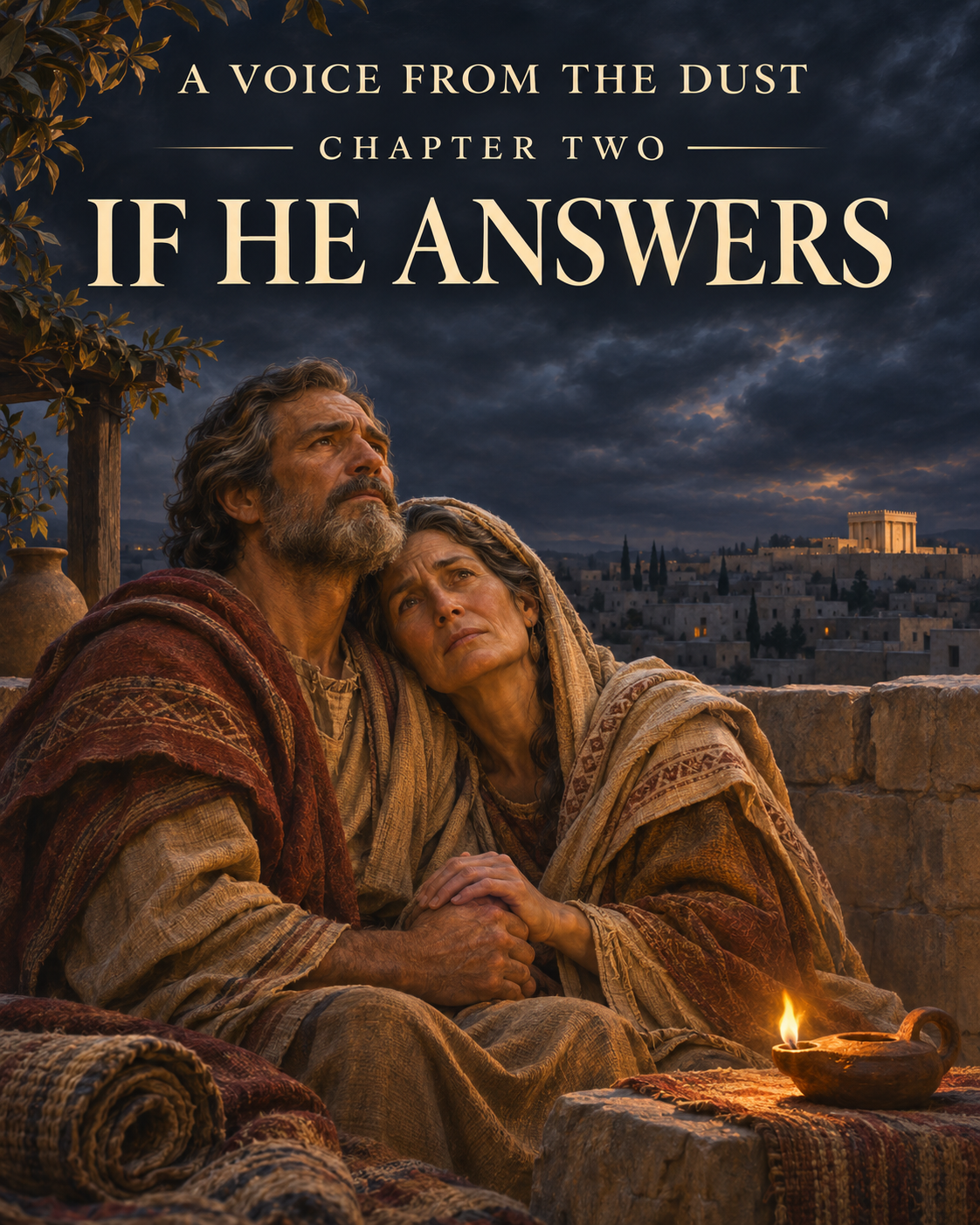
The roof was the house’s coolest and most private place. Below, dark roofs stepped toward the valley, broken by a lamp or glowing brazier. On some stood altars that had no business there: incense for the host of heaven, cakes for the queen of heaven. Josiah had torn them down when Lehi was young. They had returned so quietly no one could say when.
Sariah was already there, sitting with her back against the parapet. She did not ask him anything, and after a while he told her: the prophet at the gate, and again at the temple, and the guard who had looked at him a moment too long. He told her what Ishmael had asked of him at the gate, and what he had promised. He told her about Laban last.
He did not tell her about the stable.
When he finished, she was quiet for a long time.
“Laban warned you,” she said.
“He called it advice.”
“Laban doesn’t give advice. He gives warnings, and he gives them once.” She turned to look at him. “He was telling you that he has been told to watch. He was telling you that if someone asks him who stood at the gate, he will answer.”
“I know.”
“Do you?” Her voice was low and very steady. “You remember Urijah.”
Everyone their age remembered: a prophet from Kiriath-jearim who had preached Jeremiah’s warning, fled to Egypt when the king sought his life, then been dragged back, killed, and thrown into the common graves. Barely ten years had passed.
“Zedekiah is not Jehoiakim,” Lehi said.
“No. But Laban is still Laban.” She took a breath. “And the men who sit with the elders are still the men who buy our oil.”
Lehi did not answer.
“You were hard on Laman tonight,” she said.
“I went down to him.”
“And?”
He was quiet for a while. “I told him to wash his arm.”
Sariah sighed, and something that was almost a laugh went out with it. She shook her head at him in the dark, the way she had been shaking her head at him for twenty-six years.
“He apologized to me,” Lehi said. “Before I could say anything. He apologized to me, and I let him.”
“Of course he did. He’s been apologizing to you since he could walk.” She was quiet a moment. “When he was small and you were cross with him, he’d follow you from room to room until you weren’t. It didn’t matter whose fault it was. He only wanted you to look at him again.”
After a while she said, “Do you know what I saw in the courtyard tonight? When Lemuel made his joke about the market?”
“He was only teasing.”
“Lemuel was teasing. Laman laughed.” She looked at him. “He laughed first, Lehi.”
He tried to see it again. Laman on the trough with his head bent, Sam pouring water over the scratch, Lemuel grinning. Laman had laughed before anyone, and he had kept his eyes on his arm while he did it. Lehi had laughed with him. And over Laman’s head Sariah had given him a look, and he had not understood it.
Nephi to the market. Nephi to the gate. Nephi beside him over the Egyptian. Laman to the fold with Gaddi, because Laman was good with the land, and the land was where Laman went. Lehi had never once decided it. It had only happened, one day after another.
“He’ll never say a word,” Sariah said. “He’d cut off his hand first. But he notices.” Then, more gently: “Take him with you next time. Not Nephi. Laman.”
“He hates the market.”
“He hates being left behind. It isn’t the same thing.”
They sat without speaking. Somewhere below, a door closed.
Then Sariah found his hand in the dark. Her thumb moved over his knuckles. “I can see what those prophets’ words are doing to you,” she said. “Whatever they’ve stirred in you, you don’t have to carry it by yourself. I’m here. You know that.”
“I know.”
“I only ask one thing.” Her hand tightened on his, and when she went on, her voice was not quite steady. “I have stood by one child’s grave, Lehi.” She stopped, and he heard her draw a breath. “Don’t ask me to stand by another.”
He knew what she meant. Hoglah, who would have been their third daughter, had lived eleven days. Sariah rarely spoke her name. She did not speak it now.
In the faint light from the roofs below, he saw her lift a hand to her eyes. He reached over before she could and wiped her eyes with his thumb, and she let him.
“I’m not brave, Sariah,” he said.
“I know. I didn’t marry you for it.”
He almost smiled. “I have prayed for this city all my life. My father taught me the words before I could read them. Morning and evening, at the temple, at the table. For the king. For the city. For rain in its season. When Babylon stood at the walls, when they took the young king, I said them again, the same way.” He looked out over the dark roofs. “I said them well, but I never once stopped to listen for an answer. I can’t go on like this. I mean to ask the Lord. Truly ask. Not for rain. For an answer.”
She was quiet a long while.
“You aren’t the only one in this house who prays, you know,” she said at last.
He looked at her.
“I have prayed every night since they took the young king and the sons of the great houses to Babylon,” she said. “For ours. That whatever comes, he will keep ours.”
He had no answer. He held her hand.
“And if he answers you?” she said.
“Then I will have to do what he says.”
She looked at him, and he saw in her face that she had already understood that, before he had said it, perhaps before he had understood it himself.
“That,” she said softly, “is what frightens me.”
She leaned her head against his shoulder, and they sat until the last lamps below went out.